Smart Manufacturing Business Practices Assessment
The Business Practices Assessment helps us understand your current operations and identify meaningful opportunities for improvement. Your responses support building a Smart Manufacturing innovation roadmap tailored to your organization.
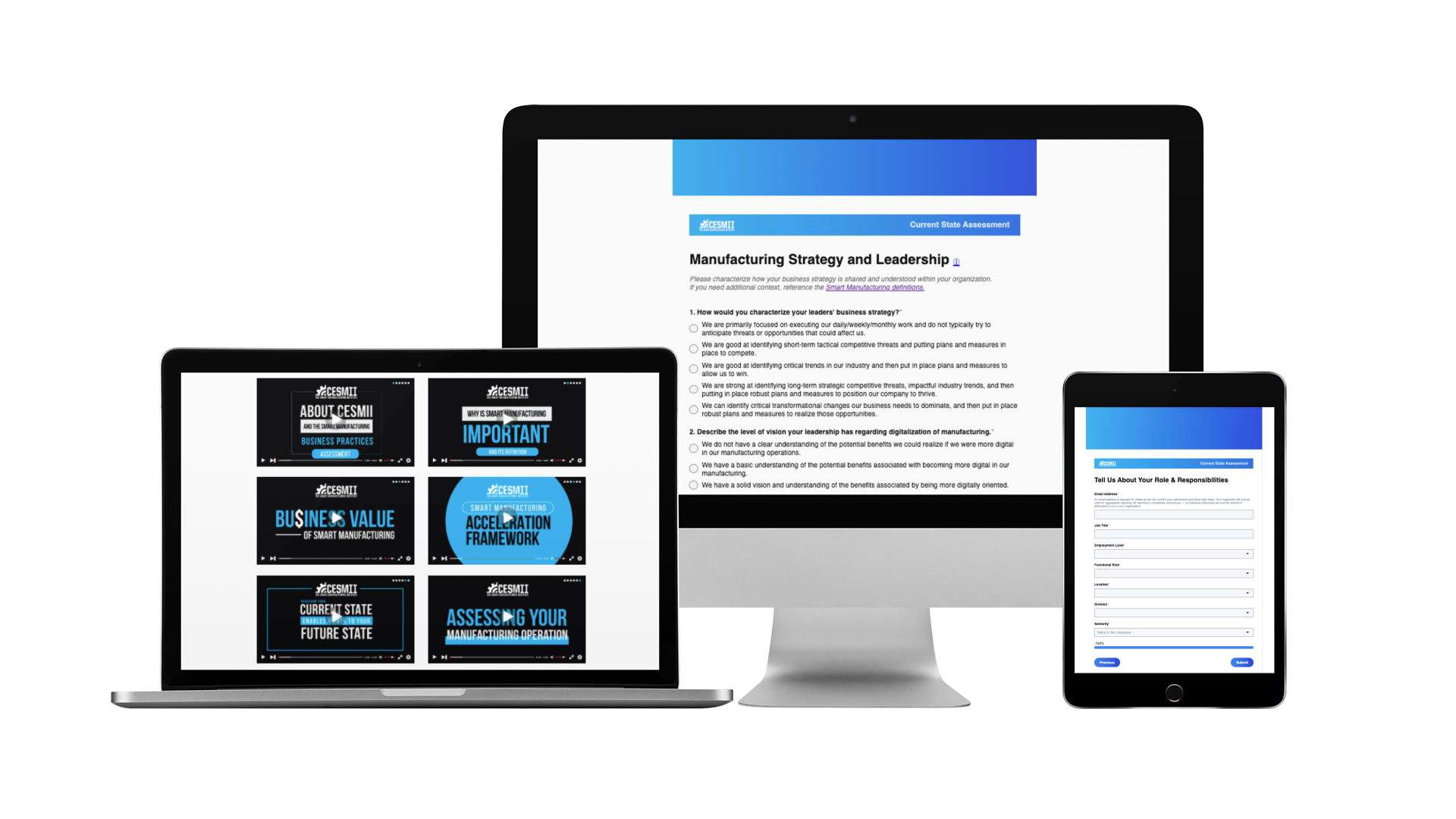
Business Practices Assessment Questions
The Business Practices Assessment is a structured survey that takes a close look at where your organization stands today across seven key areas of smart manufacturing. Before you begin, review the questions below to get a sense of what topics are covered and who on your team might be best suited to help answer them.
The assessment is designed to be completed by someone with visibility into both your operations and your organization's broader strategy. You do not need to have all the answers to get started. Here is a preview of all six sections to see the topics & questions covered before you begin.
Please characterize how your business strategy is shared and understood within your organization.
Questions 1-4
- How would you characterize your leaders' business strategy?
- Describe the level of vision your leadership has regarding digitalization of manufacturing.
- What focus does your company have on digital transformation?
- Is Smart Manufacturing seen as an opportunity?
Smart Manufacturing and digital transformation need to align with your culture and processes. Please characterize your organization.
Questions 5-7
- Are your manufacturing processes standardized and documented?
- Do you have a formalized continuous improvement methodology?
- Do you leverage data from systems for Lean Six Sigma continuous improvement?
Key to successful progression in smart manufacturing is driving the organization from trusted data, information, and metrics. Please characterize your organization.
Questions 8-11
- Are you meeting your targets and metrics (cost, quality, schedule)?
- Characterize your level of manufacturing data collection.
- Characterize the ability of your systems to understand variability, predict disruptions and causes.
- Characterize your organization's use of manufacturing data and analytical capabilities.
Understanding the breadth and depth of system infrastructure and the integration of data across them as currently implemented. Please characterize your organization.
Questions 12-14
- How extensively have you automated your manufacturing processes?
- How extensive is your implementation of software systems to support manufacturing?
- Are your manufacturing assets connected through open integration interfaces like APIs?
People, their roles, and work tasks are crucial to the digital transformation. Please characterize your organization.
Questions 15-17
- What is your approach to skills and training of manufacturing workers?
- Are employees empowered to improve manufacturing performance?
- Are employees augmented with technology to improve their work performance?
Broadening the view to your supply chain and reflecting on its resiliency and agility. Please characterize your organization's supply chain.
Questions 18-20
- Characterize how your supply chain partners view your performance and relationship.
- What is the level of data exchange and integration across the supply chain?
- Describe how you handle sharp changes and disruptions in your supply chain.
Smart Manufacturing Introduction Videos
Smart Manufacturing Definitions
Manufacturing Strategy and Leadership (Overview 0.21 Min)
- Business Strategy - While the overall business strategy will define the company goals, the technology strategy will describe how automation and IT will help to achieve these goals.
- Digitalization - is more than just making existing data digital, digitalization embraces the ability of digital technology to collect data, establish trends and make better business decisions.
- Digital Transformation - is the integration of digital technology into all areas of a business, fundamentally changing how you operate and deliver value to customers.
- Transformational Change - a shift in the business culture of an organization resulting from a change in the underlying strategy and processes that the organization has used in the past. A transformational change is designed to be organization-wide and is enacted over a period of time.
Manufacturing Excellence and Culture (Overview 0.33 Min)
- Continuous Improvement Methodology - Continuous improvement (CI) in manufacturing is a long-term business strategy that involves continuously monitoring and improving products, processes, and services. The goal is to make the manufacturing floor more efficient, streamlined, and sustainable, which can help a company gain a competitive edge. CI methodology means that there is a systematic approach to defining the initiatives being pursued and how they are prioritized.
- Lean Manufacturing – is a set of management practices and techniques to improve efficiency by reducing and eliminating non-value adding
activities and waste from the business processes. - Kaizen – is a methodology of continuous improvement that encourages the pursuit of small improvements, preferably ones that can be implemented in a short time frame.
- Lean Six Sigma - is a collaborative process improvement approach that combines Lean Management and Six Sigma methodologies to increase business process velocity. The goal of Lean Six Sigma is to reduce waste and defects, while increasing effectiveness and results.
- Six Sigma - is a set of techniques and tools used to improve business processes by minimizing variation, reducing defects and errors, and increase quality.
Data Driven Processes (Overview 0.26 Min)
- Autonomous Manufacturing Processes - are self-directed and automated manufacturing processes that require minimal human intervention. Machines, robots, and other equipment that are interconnected and communicate with systems that analyze data in real-time and make decisions, allowing them to better control production.
System Infrastructure and Integration (Overview 0.22 Min)
- Application Programming Interface (API) - A set of programmed instructions, definitions, and standards that define how one piece of software interacts with another. APIs enable greater interoperability between devices in a smart manufacturing infrastructure.
- Enterprise Resource Planning (ERP) – Manufacturing ERP systems manage and improve the use of company resources, from production scheduling to inventory control and production orders. ERP systems can be made up of dozens of integrated modules such as procurement, general ledger, material requirements planning, etc. ERP is often integrated into the product lifecycle management, manufacturing execution systems, and supply chain management systems.
- Manufacturing Execution Systems (MES) - a software application that monitors, tracks, and controls the performance of the processing of materials and production of finished products. MES applications collect performance data from multiple machines, monitor quality and manage the execution of automated and manual production tasks.
- Operational Technology (OT) – a system comprised of hardware and software that controls industrial operations. The term OT has traditionally been associated with industrial automation and controls including the hardware and software systems that control and execute processes on the shop floor including data acquisition, supervisory control systems (SCADA), programmable logic controllers (PLC), and computerized numerical control (CNC) machining systems.
- Information Technology (IT) - IT has traditionally been associated with the office environment and includes the information systems and communication infrastructure used to run the business functions. IT resources include computers, data storage, networking devices, and processes to create, process, store, secure and exchange all forms of electronic data.
- Programmable Logic Controller (PLC) – A control device with an embedded computer processor that uses logic programmed software to provide electrical or digital control to machines and processes. A PLC can replace many physical relays and hard-wired connections in a process. PLCs are widely used in industrial automation.
- Supervisory Control and Data Acquisition (SCADA) – A control system architecture used to monitor and control industrial processes. SCADA can make control decisions locally or remotely for one or more facilities.
Workforce Optimization (Overview 0.23 Min)
Supply Chain Resiliency and Agility (Overview 0.47 Min)
Key Performance Indicator (KPI) – is a quantifiable measure of performance over time for a specific business objective.
Smart Manufacturing Investment Plans (Overview 0.18 Min)
The following is a list of categories of potential Smart Manufacturing capabilities and systems:
- Augmented Connected Worker - Digital Work Instructions, Automated and aided data collection, Shift Handover Communication, Remote Assistance Communication
- Equipment and Systems Interoperability - Machine and Systems Interoperability, Industrial and Product Digital Thread, Standardization of Information Models
- Real-time Data Collection and Monitoring - Real-time production monitoring with connected machines and sensors, Digital Andon Boards, Real-time Alerts, Remote Asset Condition Monitoring, Digital Twin Predictions and What-If Analysis
- Semi-autonomous Process Optimization - Semi-autonomous process re-scheduling, Self-optimizing processes for energy utilization, Machine/Asset Predictive Maintenance
- Quality Control Mechanisms - In-process Quality Monitoring, Root-Cause Analytics
- Workplace Safety & Security - Integrated digital safety warnings
- Equipment Tracking - Mobile Asset Location Tracking, Tool and Gauge Calibration Tracking
- Inventory Control Mechanisms - Work-In-Process Inventory Control, Autonomous Material Handling, Perishable Material Tracking
- Supply Chain Optimization - Digital Supply Chain Visibility and Optimization, Materials/Parts Movement/Logistics Monitoring, Traceability Data Thread for Materials/Parts, Supplier Capability to Demand Matching
- New Business Models /Connected Customer Value - Enhanced customer service models, Mass-customization, Product Condition Monitoring, Product-as-a-Service, Performance-based product offerings, Production/Asset as-a-Service, Warranty Claim Validation
- Product Service - IoT Connected Product Monitoring, Connected Field Service Operations