Next Available: November 9 & 10, 2026
Manufacturing Information Modeling & Namespace Foundations Course™
What's the Problem?
This 12-hour, hands-on course equips manufacturing professionals to transform fragmented OT data sources into a standardized, interoperable information foundation - enabling faster deployment of Smart Manufacturing solutions across systems, sites, and supply chains.
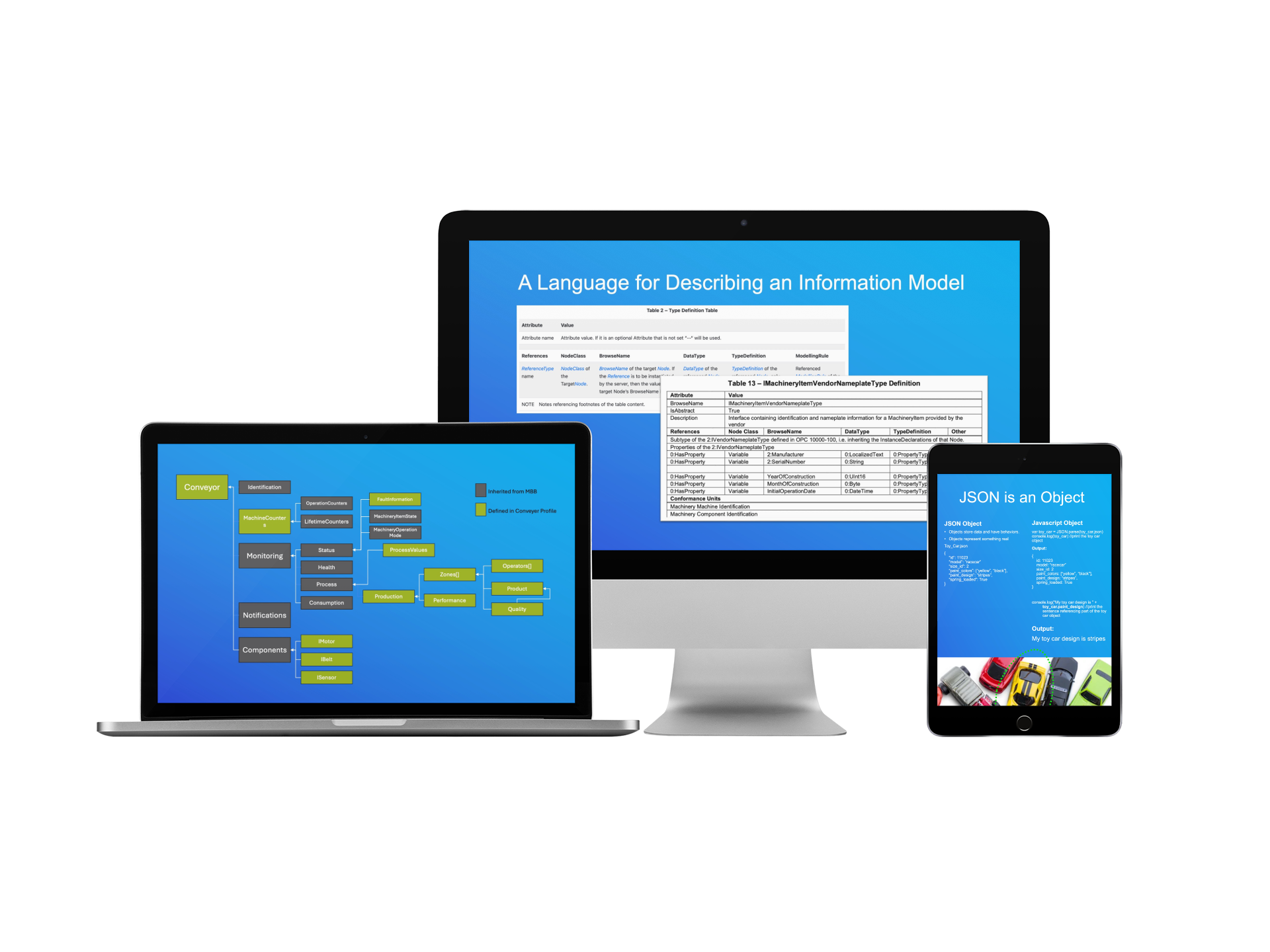
Participants will move beyond theory to design, build, and deploy real information models – Smart Manufacturing (SM) Profiles – learning how they enable interoperability help realize the vision of a Unified Namespace (UNS).
Attendee Feedback
What was the most valuable concept you learned during the Course?
"Learning CESMII's philosophy on the importance of data modeling and an accessible repository of models. There are different voices and philosophies on loosely / strongly typed approaches, and it's nice to hear in black and white CESMII's philosophy."
"Solidified the idea that UNS by itself is not the solution to solving all issues with manufacturing data. The three imperatives are key to not building into a vendor locked solution."
-
Overview
-
Audience
-
Prerequisites
-
Objectives
-
Outcomes
Course Overview
This 12-hour, hands-on course equips manufacturing professionals to transform fragmented OT data into a standardized, interoperable information foundation—enabling faster deployment of solutions – analytics, optimization, AI, etc. – across systems, sites, and supply chains.
Participants will move beyond theory to design, build, and deploy real information models – CESMII Smart Manufacturing (SM) Profiles, learning how they enable interoperability using modern architectures such as Unified Namespace (UNS) and open APIs (i3X-aligned principles).
By the end of the course, participants will be able to reduce integration effort, eliminate data silos, and enable portable applications—turning manufacturing data into a scalable strategic asset.
Target Audience
The audience for this class is manufacturing and industrial technology professionals, specifically:
- System Integrators looking to expand their customer base and help more manufacturers embrace Smart Manufacturing
- IT/OT Professionals seeking to close information gaps across manufacturing architectures
- Machine Builders aiming to standardize processes and accelerate the Quote-to-Delivery cycle
- Engineers and Technical Staff who work with industrial data, systems integration, or automation and are eager for simpler, more efficient approaches
- Solution Architects designing strategies for seamless interoperability
- Software Developers interested in adopting Smart Manufacturing Profiles to shorten their solution's time to value
In short, this course is designed for manufacturing and technology professionals across OT and IT – including
engineers, architects, and integrators focused on data standardization, reducing integration complexity, and creating the technical foundation required for smart manufacturing and industrial AI at scale.
Prerequisites
- Foundational Understanding of Manufacturing OT Systems & Data Sources (Level 2/3 systems like PLCs, SCADA, MES, Historians and integration with Level 4 systems like EAM and ERP)
- Basic Industrial Data Modeling & Contextualization Concepts (equipment models, ISA-95/88 or similar)
- Introduction to Industrial Data Architecture (UNS, Historians, Data Platforms)
- Fundamentals of APIs and common industrial protocols for Data Access, and Interoperability (Optional)
- Introductory IT/Data Skills for Manufacturing such as JSON, SQL (Optional)
Learning Objectives
- Establish a baseline of OT & IT principles to facilitate convergence of both domains
- Understand, define, and create information models and SM Profiles
- Grasp the underlying principles that make information modeling impactful
- Implement SM Profiles in several industry-leading platforms
- Apply information modeling to create knowledge graphs
- Recognize how CESMII’s 3 SM Imperatives enable application interoperability, minimize data silos/stovepipe architectures, and lower the barriers to standardization
Enable Scalable, Interoperable Smart Manufacturing Data Foundations
Participants will be able to design and implement information models that standardize how manufacturing data is structured, contextualized, and shared, eliminating fragmentation and enabling vendor agnostic innovation and interoperability across systems and platforms.
Outcome: Reduced integration cost and time; foundation for cross-platform application portability (i3X-ready)
Accelerate Time-to-Value for Digital, Analytics, and AI Use Cases
Participants will learn how to transform raw OT data into structured, contextualized information models that dramatically reduce the effort required to deploy analytics, optimization, and AI applications.
Outcome: Faster deployment of high-value use cases (AI, productivity, quality, throughput, energy, predictive maintenance)
Bridge OT and IT Through a Common Data & Architecture Strategy
Participants will gain the ability to align OT realities with IT architectures using standardized information models, enabling true OT/IT convergence without forcing system replacement.
Outcome: Improved collaboration, reduced rework, and scalable enterprise architectures
Eliminate Data Silos and Enable Enterprise-Wide Visibility
Participants will be equipped to deploy information models within modern architectures (e.g., UNS, industrial information platforms) to create a unified, navigable view of manufacturing operations across assets, lines, plants, and supply chains.
Outcome: Real-time operational visibility and cross-site comparability
Ready to Register?
Choose the path that's right for you.
CESMII Member
You may be eligible to apply member credits toward the cost of this course. Complete the short form below and we'll confirm your eligibility before processing your registration.
Not sure about your credits? Contact steve.winski@cesmii.org
Non-Member
Register now and secure your spot for the November 9 & 10 course at the full price of $1,495.
CESMII membership includes credits that apply to courses, tools, and resources. Learn about membership.
Who is the target audience for the course?
System Integrators, OT and IT professionals, consultants, machine builders, subject matter experts, and technology providers who want to understand, extend, or build SM Profiles to improve system interoperability.
How long is the course?
This 12 hour training is designed for professionals who want to understand, use, and build Information Models, with a specific focus on CESMII Smart Manufacturing Profiles.
Do I need any prior experience to attend this course?
Please refer to the Prequisites section above.
Once you're confirmed as a student, we'll share helpful links to review materials—readings and videos—to prepare you before class begins.
What are the learning objectives?
- Establish a baseline of OT & IT principles to facilitate convergence of both domains
- Understand, define, and create information models and SM Profiles
- Grasp the underlying principles that make information modeling impactful
- Implement SM Profiles in several industry-leading platforms
- Apply information modeling to create knowledge graphs
- Recognize how CESMII’s 3 SM Imperatives enable application interoperability, minimize data silos/stovepipe architectures, and lower the barriers to standardization
How often will this course be offered?
Demand will determine course scheduling.
When is the next course?
April 29 & 30, 2026 SOLD OUT
June 3 & 4, 2026 - Meeting details will be sent out following payment confirmation.
How much is the course?
$1,495.00
Can I use my membership credits to pay for the course?
If you are a CESMII Manufacturer Member and would like to apply your member credits toward this course, please contact tara.stewart@cesmii.org.